

Founders mistake silence for compliance. It’s not.
Here’s what psychological safety actually looks like across time zones — and the one shift that changes everything.
You built the hiring process. You wrote the SOPs. You onboarded the team.
And now — silence. Nodding heads in Zoom calls.
Tasks completed, but nothing more.
- no ideas
- no pushback
- no ownership
You’re wondering if offshore just… doesn’t work. It does.
But not without this.
What Most Founders Diagnose Wrong
When offshore teams go quiet, founders usually reach for the same explanations:
- cultural differences
- language barriers
- wrong hires
Sometimes those are factors. More often, they’re not the root cause.
The real issue is structural.
You’ve built a dynamic where speaking up feels risky — where the cost of being wrong, misunderstood, or “out of lane” outweighs any benefit of contributing.
Your team isn’t disengaged.
They’re protecting themselves from consequences they’ve learned — consciously or not — to expect.
This is psychological safety. And it’s not a soft, feel-good concept. It’s the single strongest predictor of team performance according to Google’s decade-long Project Aristotle research.
No psychological safety — no initiative. Simple as that.
What Founders SeeSilence in meetings. Tasks done, but nothing extra. No questions. No ideas volunteered.
What’s Actually HappeningTeam members fear judgment, correction, or being seen as overstepping. Safety is absent.
The False FixMore process. Stricter KPIs. More check-ins. These increase pressure — and deepen silence.
The Real FixConsistent signals that being honest, asking questions, and making mistakes is genuinely safe.
The Three Things BPO Founders Get Wrong
01 — Confusing Politeness for Engagement
Many offshore cultures — particularly across Southeast Asia and South Asia — have deeply embedded norms around deference to leadership.
“Yes” often means “I understand you said that“ not “I agree“ or “I know how to do this“.
Founders who read politeness as alignment are building on a misread signal.
The fix isn’t to demand bluntness. It’s to create specific, low-risk moments where honest input is genuinely invited — and then visibly acted on.
02 — Leading with Authority Instead of Curiosity
When founders join team calls leading with solutions, updates, and directives — and rarely with questions — they signal that the call is a download, not a conversation.
Over weeks and months, the team learns their role:
- receive
- confirm
- execute
Don’t interpret. Don’t suggest. Don’t ask.
“The most powerful question a founder can ask their offshore team isn’t ‘Did you complete this?’ — it’s ‘What would you have done differently?'”
— Your Virtual People, Team Culture Practice
03 — Skipping the Relationship Before the Workflow
Trust is not built in an onboarding document. It’s built in the small, consistent moments where someone feels seen as a person — not a resource.
Founders who go straight to workflow without investing in relationship are renting compliance, not building a team.
This doesn’t require hours of small talk. It requires intentionality. A genuine question about their weekend.
Remembering a detail they shared. Acknowledging when they did something well — specifically, not generically.
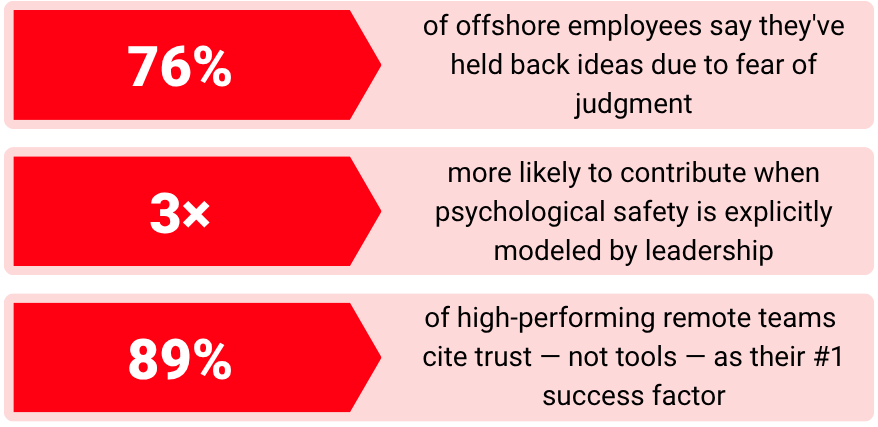
What Psychological Safety Actually Looks Like in Practice
It’s not a workshop. It’s not a survey.
It’s a set of behaviors you model — consistently, over time — until your team believes the environment is genuinely safe.
- Normalize not knowing. Say “I don’t know — what do you think?” out loud, in front of the team. Model that uncertainty is safe.
- Reward honesty over harmony. When someone speaks up, thank them openly. The team notices how you respond.
- Share mistakes from the top. Tell your team when you were wrong and what you learned. It shows them it’s okay to be human.
- Ask for input before decisions, not after. “Thinking of changing X” invites input. “Decision made” just announces it.
- Create async-safe channels for honesty. A shared doc question can reveal more truth than ten meetings.
The Long Game
Psychological safety isn’t built in a quarter. It accumulates — through hundreds of small moments where your team learns whether speaking up is worth it.
- every time you thank someone for flagging a problem
- every time you admit uncertainty
- every time you act on their input
You’re making a deposit.
When the balance is high enough, something shifts. Your team stops waiting to be told what to do.
- they start thinking three steps ahead
- they bring problems before they escalate
- they own outcomes — not just tasks
That’s the team you were trying to build when you went offshore. It was always possible. It just needed the right conditions first.
Recent Comments